
SIR – Special Intensive Revision
This is a process conducted by the Election Commission of India to update and correct the electoral roll (voter list).
SIR refers to a large-scale, intensive revision of electoral rolls by the Election Commission of India under its constitutional and statutory powers. Usually triggered in anticipation of high-stakes elections or when the rolls have remained largely unchanged for years, the SIR involves steps such as fresh enumeration forms, house-to-house verification by Booth Level Officers (BLOs), document verification of voters, deletion of ineligible entries, and inclusion of those omitted. The SIR 2025 in Bihar, where more than 8 crore voters were to be re-verified, is the latest example.
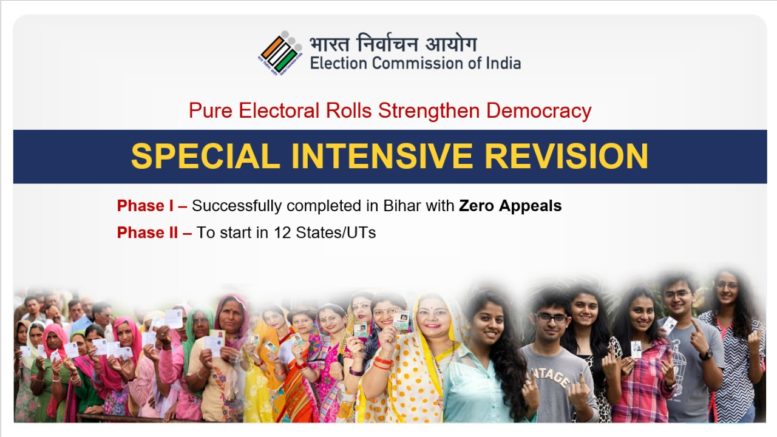
What happens during SIR? 🗳️
During Special Intensive Revision:
- New eligible voters can apply to be added to the voter list.
- People who have moved away or passed away can be removed.
- Existing voters can correct details like name, age, or address.
- Booth Level Officers (BLOs) may verify voters at their homes.
The SIR exercise offers multiple benefits for democracy and electoral integrity.
- Reduces ghost voters and multiple registrations
- Reflects demographic changes
- Improves inclusion of marginalised groups
- Strengthens transparency and trust
- Facilitates efficient polling logistics
The major objectives of conducting a Special Intensive Revision are:
- Accuracy: Update the electoral roll by removing duplicate entries, deceased voters, and ineligible persons.
- Inclusion: Add all eligible citizens, including first-time voters, migrants, and those previously left out.
- Legitimacy: Strengthen trust in the election system by ensuring the principle of “one person, one vote.”
- Demographic Adjustment: Reflect population changes such as migration, relocation, and newly eligible voters (18+).
- Pre-Election Preparedness: Ensure a clean and updated voter list for smooth conduct of upcoming elections.
Example
If the Election Commission of India announces SIR 2026, it means they are conducting a special drive to update the voter list before elections.
Bihar SIR 2025
Uttar Pradesh SIR 2026
Key points:
- The electoral rolls were first created by the Election Commission of India after the adoption of the Constitution.
- This process was carried out under the Representation of the People Act, 1950.
- The first nationwide voter list was prepared for the 1951–52 Indian general election.
- It included all eligible citizens aged 21 and above at that time (the voting age was later reduced to 18 in 1988).
