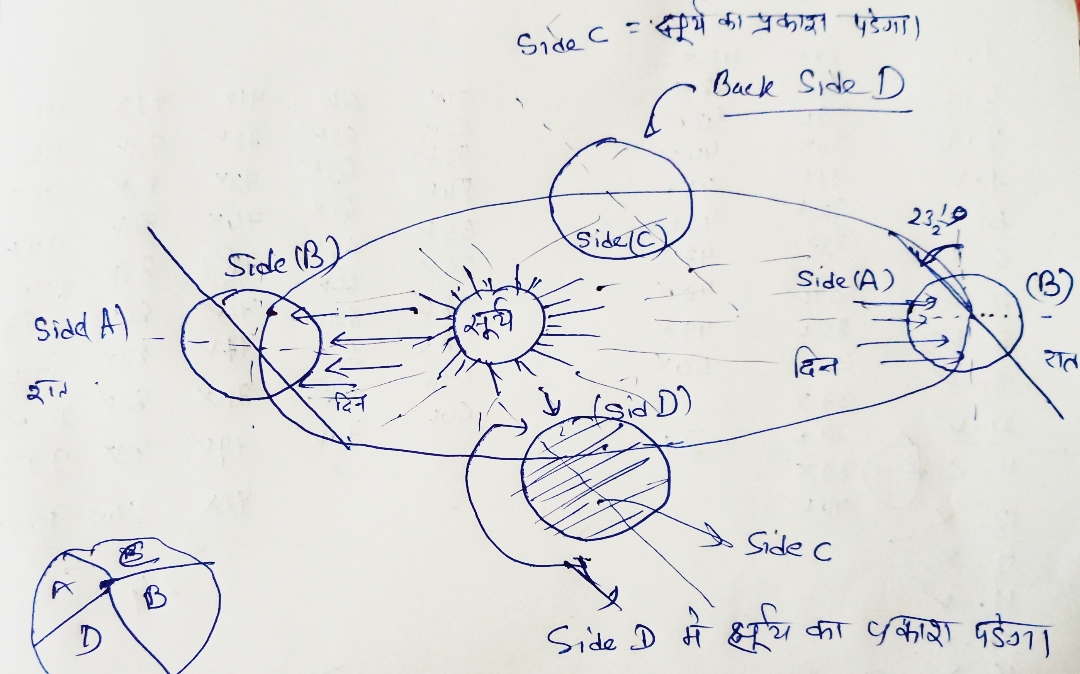
पृथ्वी जब सूर्य के चारों ओर परिक्रमा करती है, तो उसकी स्थिति के अनुसार विभिन्न ऋतुएँ किस प्रकार आती हैं?

Discover how the Earth's revolution around the Sun, coupled with its axial tilt, is responsible for the diverse seasons. This explanation covers the mechanisms, solstices, and equinoxes, detailing how varying sunlight intensity leads to summer, winter, spring, and autumn globally.

ankitasharma70300
@ankitasharma70300
198 views
Article Image

प्रश्न: पृथ्वी जब सूर्य के चारों ओर परिक्रमा करती है, तो उसकी स्थिति के अनुसार विभिन्न ऋतुएँ किस प्रकार आती हैं?
उत्तर: पृथ्वी अपनी धुरी पर लगभग 23.5 डिग्री झुकी हुई है। इसी झुकाव के कारण सूर्य के चारों ओर परिक्रमा करते समय, पृथ्वी के अलग अलग गोलार्धों पर सूर्य की किरणें सीधी या तिरछी पड़ती हैं:

  1. अक्टूबर-नवंबर के समय: उत्तरी गोलार्ध में शरद ऋतु, दक्षिणी गोलार्ध में वसंत ऋतु।
  2. जनवरी-फरवरी के समय: उत्तरी गोलार्ध में शीत ऋतु, दक्षिणी गोलार्ध में ग्रीष्म ऋतु।
  3. मार्च-अप्रैल के समय: उत्तरी गोलार्ध में वसंत ऋतु, दक्षिणी गोलार्ध में शरद ऋतु।
  4. जुलाई-अगस्त के समय: उत्तरी गोलार्ध में ग्रीष्म ऋतु, दक्षिणी गोलार्ध में शीत ऋतु।


Questions Asked

What is the primary cause of seasons on Earth?
The primary cause of seasons is Earth's axial tilt (approximately 23.5 degrees) relative to its orbital plane around the Sun, combined with its revolution. This tilt causes different parts of Earth to receive more direct sunlight at different times of the year.
Does the Earth's distance from the Sun cause seasons?
No, the variation in Earth's distance from the Sun throughout its elliptical orbit is minor and not the primary cause of seasons. In fact, the Earth is closest to the Sun during the Northern Hemisphere's winter.
What are solstices and equinoxes?
Solstices are points in Earth's orbit where the Sun reaches its highest or lowest point in the sky, marking the longest or shortest days of the year (e.g., Summer Solstice, Winter Solstice). Equinoxes are when the Sun is directly over the equator, resulting in roughly equal day and night worldwide (Spring Equinox, Autumnal Equinox).
Why do the Northern and Southern Hemispheres have opposite seasons?
Because of Earth's axial tilt, when one hemisphere is tilted towards the Sun (receiving more direct sunlight and experiencing summer), the other hemisphere is simultaneously tilted away (receiving less direct sunlight and experiencing winter).
How does the angle of sunlight affect seasons?
A more direct (closer to 90-degree) angle of sunlight concentrates solar energy over a smaller area, leading to higher temperatures and summer. A less direct angle spreads the same amount of solar energy over a larger area, resulting in lower temperatures and winter.

Comments

Please login to participate in discussion. Login
🚀 TutorliV Mobile App

One App.
Every Learning Experience.

Discover teachers, prepare for competitive exams, read quality articles, attempt mock tests and build your own learning identity from one powerful platform.

Find verified teachers nearby
Attempt unlimited mock tests
Daily Current Affairs & Study Notes
Create your own teaching page
Nearby Teacher
2.3 km Away
Mock Tests
25,000+
⭐ 4.9 Rating

🎯 Popular Topics

Explore the most searched educational topics.

🚀 Find Jobs by State & Department

Explore Sarkari Jobs, Admit Cards & Results easily on TutorliV

🔥 Popular Job Categories